
Alexander McQueen was one of the most celebrated fashion designers of his generation, known for his highly original designs that married artistry with exceptional technical ability. His contribution to fashion as a whole is legendary, and his fierce and futuristic footwear was truly groundbreaking - introducing abstract silhouettes, sculptural styles and technical innovation never attempted before. With his desire to make women feel fierce and powerful, we saw a very fresh vision of what women's footwear could become aesthetically too.
Known to his friends and family as Lee, he was born and educated in London. He left school at 16 to become an apprentice on Mayfair's Savile Row. First at Anderson & Sheppard, and then at Gieves & Hawkes, where he learned the intricacies of traditional fine tailoring techniques. He later worked as a pattern cutter at the costumiers Angels & Bermans.
At age 20, McQueen began working as a pattern cutter for the avant-garde, London-based Japanese designer Koji Tatsuno, before moving to Milan to join Romeo Gigli. McQueen returned to London to complete his MA in Fashion Design at CSM. Already a proficient tailor, here he learned how to tailor fashion as an art form. His graduate collection was astonishing, praised far and wide. The entire collection was bought by Isabella Blow, a true testament to his natural talent and excellent technical ability.
McQueen launched his own label in 1992. He was appointed head designer at Givenchy in 1996, succeeding John Galliano. In December 2000, the Gucci acquired a majority stake in McQueen's company, where he continued to serve as creative director. Lee's work was admired for its powerful blend of subversion and tradition. He was not afraid to express his beliefs in his work, creating wearable art that was fuelled by passion, and executed to impossible perfection.
"You've got to know the rules to break them. That's what I'm here for, to demolish the rules but to keep the tradition."
The 1995 Highland Rape collection was informed by his Scottish heritage, referencing the Highland Clearances of the 18th and 19th centuries, when tenants in the Scottish Highlands were forcefully evicted. Inspired by the 19th century, he often drew on Gothic influence, exploring parallels to the present day.
McQueen worked with a loyal, close-knit team and was known for his ability to recognise talent in other creators. For his spectacular catwalk shows, he commissioned an amazing array of one-off pieces. To realise this vision, he worked with a diverse range of materials and craftspeople – from skilled woodcarvers to 'plumassiers' (feather workers), embroiderers to leather workers. As well as his longstanding collaboration with Shaun Leane, he worked closely with milliner Philip Treacy.
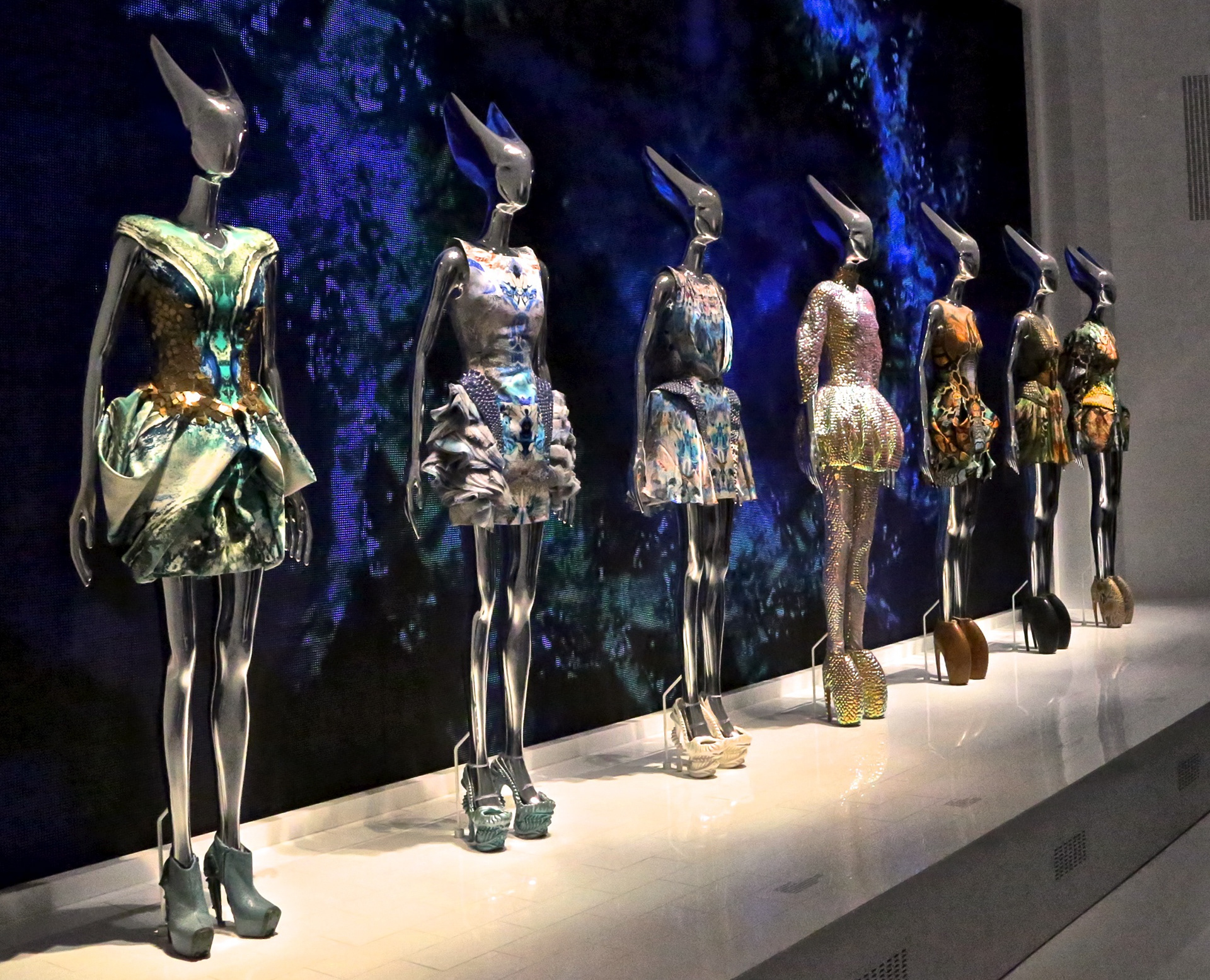
By walter sedriks - https://www.flickr.com/photos/sedriks/24841252036/, CC BY 2.0, https://commons.wikimedia.org/w/index.php?curid=145359301
McQueen's final runway presentation, Plato's Atlantis, referenced the legendary island described by the Greek philosopher, which sank into the sea – predicting a dystopian future in which humanity would need to evolve to survive. McQueen incorporated references to Ridley Scott's H.R Geiger's work in Alien and developed a host of new shapes.
The iconic Armadillo boot – an entirely new shoe silhouette, which completely rewrote the natural anatomy of the human foot. Only 24 pairs exist: 21 were made during the initial production in 2009, and three were made in 2015 for a charity auction. The shoes are named for their unusual shape, and the texture created from the convex sequins, snakeskin and , said to resemble an armadillo. Each pair is approximately 12 inches/30 cm from top to sole, with a 9-inch/23 cm stiletto heel.
Critical response to the armadillo heels was extensive, both immediately following the show and in retrospect. They are considered iconic in the context of the show, Lee's body of work, and in fashion history in general. Critics have referred to them as both grotesque and beautiful, sometimes in the same review. Some seem to have missed the point - that Lee wasn't trying to make women look pretty - he was empowering them with armour. Shahidha Bari, professor of fashion cultures, described them in 2020 as a parody of a ballerina's pointe shoes: "It (also) makes explicit the mercilessness of the pointe shoe".
Lady Gaga certainly understood their power. She became a friend of McQueen's shortly before his suicide, and premiered Bad Romance at the Plato's Atlantis show. For the single's video, in 2009, Gaga wore the opalescent "Neptune's Daughter" outfit that closed the Plato's Atlantis show, including the matching armadillo shoes. She also wore armadillo heels in python skin at the MTV Video Music Awards in September 2010; she described this look in 2018 as the top outfit of her career. Later that month, she wore the same pair with a dress made of hair in New York. She currently owns the three pairs commissioned for the charity auction.
The 3D printed Alien shoe, with its biomorphic, constricting spine slithering around the foot and heel suggests a sinister symbiosis. This shoe’s distinctive morphing of human and mechanical forms was inspired by the artwork of H.R. Giger, a member of the special effects team for Ridley Scott’s film Alien .
Speaking about his artistic preoccupations to the BBC in 1981, Giger said, ‘My pictures are about things I like, things I hate or things I am afraid about. I always want to find out what is inside of me, what kind of creature. I like very much the combination of machine and human and biological things’.
Made from 3D printed resin, the shoe combines a reference to Giger’s futuristic vision with cutting-edge technology. In a gruesome flourish, a single finger curls across the wearer’s toes.
Eleven different versions of the ‘Alien’ shoe appeared in the Plato’s Atlantis catwalk presentation. As the models merged more deeply into McQueen’s underwater world, the shoes subtly evolved from white matte, to shiny silver and finally a shimmering light blue.
The Titanic boot, with aged algae coloured leather and industrial articulated heel with tarnished metal rivets evoke the doomed ocean liner after which it is named. Whether he's referencing the damaged hull, or the punched holes in Meccano, the pierced metal makes a statement either way. As with all his work, there is intelligent consideration and dark humour in every choice.
I find it devastating that we lost this gifted man to the ravages of depression. His contribution to the creative world was a testament to his passion, commitment, true artistic brilliance - and a commitment to excellence in craft that I have not seen before, or since. His work was immeasurably beautiful in the smartest of ways, and truthful, but most of all, powerful.